
-
Patricia, 58, who never finishes her own mealsPatricia cooks elaborate dinners and somehow ends up eating the smallest portion while standing at the counter. She's always getting up to refill someone else's water glass, adjust the temperature, or check on something in the kitchen. By the time she sits down, she's eaten four things in between. Her family once staged an intervention where they physically kept her at the table. Patricia lasted ninety seconds before thinking of something else that needed doing.
-
Margaret, 31, new mom running on four cups of coffee dailyMargaret operates in a state of controlled chaos that would qualify most people for medical leave. She's running on coffee, adrenaline, and occasionally the memory of what sleep felt like. Her husband suggested she nap when the baby naps. Margaret looked at him like he'd suggested she take up skydiving. There is laundry to fold, bottles to sterilize, and apparently no time for something as frivolous as rest.
-
Diane, 64, who remembers everyone's birthday including the dog'sDiane maintains a mental calendar that would make Google Calendar jealous. She knows not just birthdays, but the preferred cake flavor for each family member and several of the dog's friends. She has never missed sending a card. Her daughter suspected Diane had actual CIA-level organizational skills. She does not. She just cares with an intensity that borders on supernatural. It is both impressive and slightly exhausting.
-
Susan, 47, the home remedy encyclopediaSusan responds to any ailment with a home remedy she's gathered from various sources, most of which sound like witchcraft. A cough gets honey and ginger. A headache gets a specific type of tea. Something broken gets a poultice of ingredients that should not work together. Her family has learned that Western medicine and Susan's remedies coexist. Sometimes her suggestions work. Sometimes they're merely harmless. She remains convinced that everything can be cured with the right combination of natural ingredients.
-
Helen, 73, the woman with unlimited snacks for situationsHelen has snacks hidden in locations that only she knows about. There's a cache in the linen closet, emergency supplies behind the pantry, and probably something under her bed for situations she hasn't anticipated yet. Family members stumble upon these stashes randomly and feel like treasure hunters. Helen guards her snack collection with the intensity of someone protecting national secrets. A visitor arriving announces Helen will have the perfect thing. She always does.
-
Rachel, 35, whose texts escalate at an alarming rateRachel's text messages follow a pattern of increasing urgency. The first is casual. The second adds an exclamation point. By the fifth, she's implied that the world is ending and immediate action is required. Her children have learned to respond quickly not because the message is actually urgent, but because the escalation pattern is terrifying. Usually the situation is something like 'did someone eat dinner.' The texting velocity says emergency. The actual content says normal question.
-
Carol, 52, love language expressed through feeding peopleCarol's primary method of showing affection is to feed people. A friend visits and suddenly there are four dishes. Family members call and she immediately plans what to cook them. Her love is measured in calories and effort. Her family has collectively gained weight just through proximity to her cooking. Carol interprets this as success. She is currently planning the next gathering because there is never too much food. There is only too little love expressed through casserole.
-
Deborah, 42, owner of seventeen sweaters for mild weatherDeborah has a sweater drawer that contains exclusively light sweaters for those not-quite-cold moments when a jacket is excessive. She wears them year-round despite the actual temperature. Her daughter once suggested she was simply cold-blooded. Deborah looked at the drawer. No, she just appreciates the layer. This logic has allowed her to accumulate sweaters for every conceivable temperature scenario between sixty and seventy degrees.
-
Lisa, 29, crier at every family event without failLisa cries at everything. The kids' graduation, the dog's birthday, a wedding, a retirement party, her nephew learning to ride a bike. Happy tears, sad tears, overwhelmed tears, and sometimes tears she can't quite explain. Her family keeps tissues within arm's reach at all events. She claims she's not actually sad. Something just hits her in the feelings. It's become part of the family experience. Event planning now includes 'box of tissues for Lisa.'
-
Olivia, 55, who holds everyone's emergency medical informationOlivia keeps an actual record of everyone's medical history, allergies, and preferred physicians. She's the person everyone calls in a medical crisis because she has the information. Her organizational system is something between a government database and a grandmother's recipe card collection. She updates it without being asked. Family members occasionally discover she has information they didn't remember telling her. She just knows these things. It's her superpower.
-
Victoria, 38, empty nester who discovered yogaVictoria's kids left for college and she immediately became a yoga person. She had never expressed interest in yoga before. Now it's her primary personality trait. She talks about chakras and downward dog with the enthusiasm of someone who discovered a secret religion. Her friends are supportive but slightly confused. Victoria has found peace. Her family has learned that asking her to take a break from yoga is like asking her to abandon enlightenment.
-
Martha, 67, the recipe keeper of family traditionMartha has hand-written recipe cards for every family favorite. They're stained with cooking residue, annotated with personal notes, and somehow the only versions that turn out correctly. Her daughter has tried to replicate the recipes exactly with disappointing results. Martha's version remains superior. The recipes are not actually different. Martha's hands remember something the written instructions cannot capture. These recipes are heirlooms disguised as cooking instructions.
-
Natalie, 44, perpetual organizer of other people's livesNatalie has opinions about everyone's choices and the organizational system they should adopt. She means well. She is also completely unable to let others figure things out independently. Her family has learned that her suggestions come with genuine care but also persistent follow-up. She checks back. She wants to know if the system worked. Her love language is helping people get their lives in order, whether or not that's what she was asked to do.
-
Joyce, 28, new mom who cannot figure out how she got hereJoyce moves through motherhood with the general attitude of someone mildly surprised by her own circumstances. There's a small human that somehow depends on her. She's doing her best. Her best involves more coffee than any single person should consume and a permanent state of confusion about how laundry multiplies. She occasionally stops and thinks about how she's actually responsible for another person. Then the baby cries and she returns to survival mode.
-
Rosa, 61, keeper of every sentimental item everRosa keeps things for reasons. Notes from her kids, artwork from kindergarten, ticket stubs, dried flowers from arrangements. Her home is an archaeological site of sentimentality. Her daughter suggested throwing out some of the older items. Rosa looked personally wounded. Those represent memories. What if she forgot the feeling of that moment without the tangible item? Logically, she has plenty of other items to trigger memory. Rosa operates on pure heart, not logic.
-
Audrey, 50, who talks to her plants like they're familyAudrey genuinely believes her plants respond better to conversation. She provides running commentary while she waters them, tells them about her day, and occasionally apologizes to them for not being around as much lately. Her daughter walked in once to find Audrey having what appeared to be a serious conversation with a fern about next Tuesday's plans. Audrey did not break character. That fern is part of the family. It deserves regular updates.
-
Brenda, 39, who reads parenting books obsessivelyBrenda has a library of parenting advice that would shame most psychology departments. She reads late into the night about developmental stages, behavioral psychology, and nutritional optimization. She tries to implement everything. Sometimes she succeeds. Sometimes she abandons the method midway because her actual child has not read the same book. Her therapist suggested she might be overthinking. Brenda bought another book on the topic.
-
Kathleen, 72, the ultimate question-askerKathleen asks questions about everything. Why did someone choose that job. What does their friend actually do. Is that sweater the right color for their skin tone. She's not being rude. She's just genuinely curious about the reasoning behind every human choice. Her family has learned that answering one question prompts four follow-up questions. Conversations with Kathleen are interviews conducted by someone who cares about the subject matter.
-
Tammy, 53, professional apologizerTammy apologizes for things that require no apology. She's sorry she called. She's sorry for existing during someone's busy day. She's sorry she can't help more. Her family keeps telling her to stop apologizing. Tammy apologizes for apologizing. It's a compulsive expression of her general anxiety that everyone else has enough to deal with. She genuinely means well. She also genuinely believes she's always slightly in the way.
-
Edna, 81, who has strong opinions about proper etiquetteEdna has rules about how things should be done. Proper tea temperature, appropriate thank note timing, the correct fork to use. She's not judgmental about it. She simply knows the right way. Family members occasionally test her with intentional etiquette violations just to see her gentle correction. She never gets angry. She simply educates. Her family has inadvertently become knowledgeable about proper place settings.
-
Violet, 45, the backup plan makerViolet has contingency plans for contingency plans. She's thought through worst-case scenarios that nobody else has even imagined. A family road trip involves backup routes, emergency supplies, and a detailed communication plan. She means well. Her family sometimes feels suffocated by the preparation. Violet would rather over-prepare than be caught unprepared. She sleeps better knowing that Plan C exists even if Plans A and B go perfectly.
-
Constance, 33, who calls to tell stories that could have been textsConstance calls family members with what could reasonably be text messages. She needs to hear their voice while telling them about something mildly interesting that happened. Her sister once timed the call. Five minutes of story that took ninety seconds to explain. But Constance wanted to share the experience, not just the information. She's a connector who speaks in long narrative form. Her family loves her and occasionally blocks out time for her updates.
-
Wendy, 30, confused about how she became a full-time parentWendy looks at her children sometimes like she's slightly surprised they're hers. Biologically she knows they are. She just doesn't quite remember the moment she became the person responsible for keeping two other humans alive. She's handling it. The handling involves more improvisation than she'd like. She's reading parenting blogs at midnight because something seemed wrong earlier. Usually everything is fine. Her confidence that she's doing this correctly is approximately thirty percent.
-
Pamela, 66, whose Facebook is a family broadcast servicePamela posts everything. Grandchildren's achievements, family updates, old photos, her thoughts on current events, and the occasional photo of her lunch. Her posts are lengthy and include unnecessary details. Her family has learned that informing Pamela of something is equivalent to publishing it. She is not malicious. She is simply excited to share. Her Facebook represents her genuine enthusiasm about life and an incomplete understanding of oversharing.
-
Noelle, 51, who keeps magazine clippings she'll never useNoelle has boxes of magazine clippings for recipes she will never make, decorating ideas she will never implement, and life hacks she will never try. She's a collector of intentions. The clippings represent imaginary versions of herself that exist in her mind. Her actual self barely has time to keep up with reality. But the potential self that makes those recipes and implements those ideas feels possible in the magazine pictures.
Three rules for a mom roast that actually lands.
Find her one signature behavior.
The text-escalation, the snack hiding, the way she remembers everyone's birthday. One thread, pulled tight.
Make the audience nod, not gasp.
Mom roasts work when everyone in the family has the same memory. Stay in shared territory.
End where she'd want it to end.
Bring it back to why she's the heart of the room. The roast earns the tears.
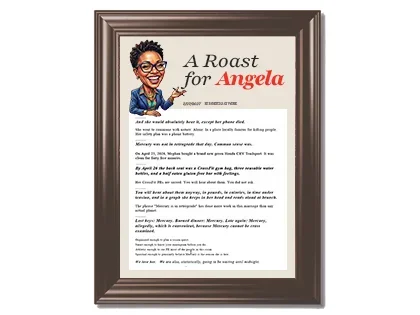
Want a roast written for the actual mom?
RoastGift writes custom roasts about real moms: the specific snack, the specific catchphrase, the texts everyone screenshots. Speech-ready, delivered fast, makes a great gift for Mother's Day, her birthday, or any moment that calls for a real toast.
Visit RoastGift.com →Frequently Asked Questions
How do I write a roast joke about my mom without hurting her feelings?
Start with affection as baseline. The joke should come from a place of genuine love and shared history. Focus on habits, quirks, and behaviors that she's probably aware of and might even joke about herself. Avoid anything about appearance, intelligence, or parenting choices. The goal is to celebrate her while gently poking fun at something endearing.
What are good topics to roast a mom about?
Her organizational habits, the way she never finishes her own meals, her love language of feeding people, her ability to cry at family events, her hobby obsessions, her relationship with texting or social media, her home remedies, or her general inability to slow down. These are affectionate territory that most moms will laugh about. Avoid anything touching on her parenting, her body, or her relationships with family members.
Is it ever okay to roast a mom in front of her friends?
Yes, with calibration. A well-executed roast in a celebratory setting like a birthday party or Mother's Day gathering can feel like a tribute rather than a critique. The key is audience awareness. Make sure she'll laugh in front of her friends, not feel embarrassed. If there's any doubt, save it for family only. The best public roasts feel like inside jokes that the whole group loves.
What makes a mom roast funny instead of just mean?
Specificity and affection. A roast about a particular habit told with warmth feels like celebration. A generic roast about moms in general feels like criticism. Focus on the specific person, the specific thing she does, and tell it like remembering something loved about her. The listener should feel that underneath the joke is genuine appreciation and shared history.